
Pruning
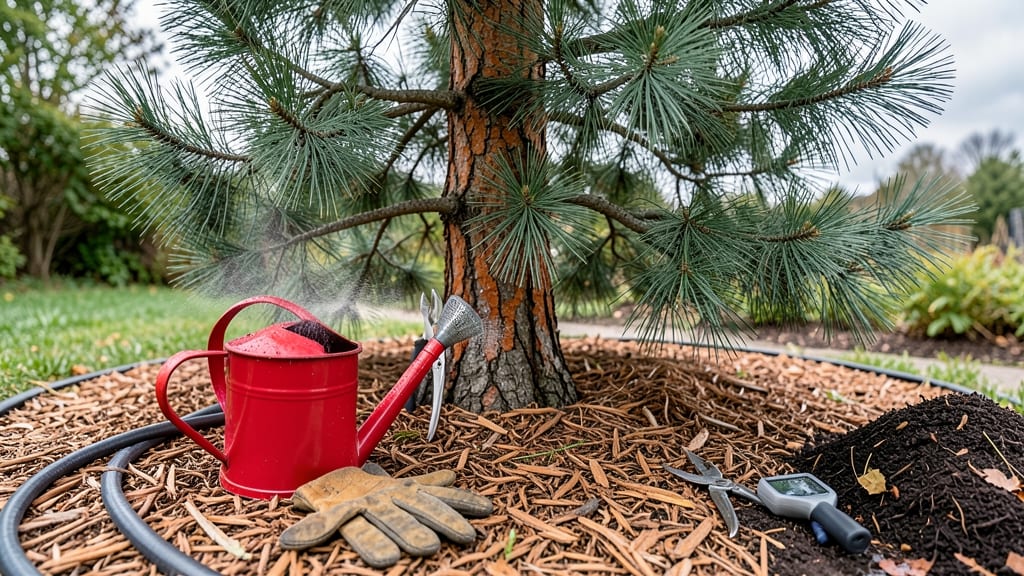
Pine trees thrive with almost no fuss if you nail how to care for a pine tree—just focus on three basics: watering, sunlight, and occasional pruning. 🌲 I’ve watched my 20-foot ponderosa pine stand strong for a decade with just these simple habits—no fancy equipment or constant attention required.
Most people overwater, thinking pines need constant moisture like lawns. In reality, they prefer deep but infrequent watering—once a week in summer, less in winter. Well-draining soil is key; clay or compacted ground will suffocate those roots.
And yes, they do need full sun—at least 6 hours daily—or they’ll turn into sad, spindly shadows.
The real magic happens when you prune correctly: remove dead branches in late winter, and skip the urge to "shape" them like shrubs. A healthy pine drops needles naturally—10% annually is normal—but yellowing clusters mean stress. Mulch helps retain moisture and keeps roots cool.
This care routine works for pines of all sizes, from dwarf varieties to towering giants. The payoff? A tree that stays lush, disease-resistant, and neighborhood-proud for decades with minimal effort.
📚 In This Guide
- What you need
- Instructions
- Tips and common mistakes
- Wrapping up and next steps
What you need
- ● Pruning shears or loppers – Sharp, bypass-style shears (4-6" blades) for small branches; loppers (8-10" blades) for thicker limbs.
- ● Pruning saw – For branches thicker than 2" (folding saw with a 12-16" blade).
- ● Gloves – Heavy-duty, cut-resistant gloves (gardening or pruning-specific) to protect from sap and sharp branches.
- ● Disinfectant (70% isopropyl alcohol or bleach solution) – 1 part bleach to 9 parts water to sterilize tools between cuts.
- ○ Tree wound sealant (optional but helpful) – For larger cuts (1+ inch in diameter); choose a product labeled for conifers.
- ● Ladder or extension pole – Aluminum or fiberglass ladder (20-30 ft tall) or a telescoping pole for high branches.
- ● Heavy-duty trash bags – For debris removal (20-30 gallon capacity).
- ● Watering can or hose with nozzle – For deep watering (1-2 gallons per tree, depending on size).
- ● Slow-release fertilizer – Balanced (10-10-10 or 20-20-20 NPK ratio) for established trees; apply in early spring.
- ● Mulch (pine bark or wood chips) – 2-4 inches thick, kept 6" away from the trunk.
- ● Soil pH tester kit – To check acidity (pines prefer pH 4.5-6.0).
- ● Pest/disease monitor traps – For early detection of aphids, spider mites, or fungal issues.
- ○ Tree growth regulator (optional) – For controlling excessive growth in ornamental pines (follow label instructions!).
Step-by-step instructions for cultivating a healthy pine tree
Here's the straightforward approach I've used for decades to keep pines thriving with almost no fuss.
☀️ Step 1: Select the Right Location for Your Pine
Pines demand full sun exposure—at least 6-8 hours daily—to develop strong, disease-resistant wood. I always check the mature height of the variety first; a 30-foot tree needs at least 15 feet of vertical clearance above power lines or structures. Look for areas with well-draining soil—pines hate soggy roots.
Test your spot by digging a 12-inch deep hole. If water pools after 30 minutes, amend the soil with 2-3 inches of compost mixed into the top 6 inches to improve drainage. The ideal planting site mimics the pine's natural habitat: open, sunny, and slightly acidic soil with a pH between 4.5-6.0.
💧 Step 2: Water Deeply and Infrequently
Newly planted pines need 1-2 gallons of water weekly during the first year, delivered in deep soakings rather than frequent shallow watering. I use a soaker hose at the base for 30-45 minutes to encourage deep root growth. Overwatering causes root rot, which is fatal—you'll see yellowing needles and a foul smell at the base if this happens.
After the first year, mature pines are remarkably drought-tolerant. Water only when the soil 3-4 inches down feels completely dry to the touch. A simple test: push a screwdriver into the soil—if it resists, your pine has enough moisture. Mulch with 2-3 inches of pine needles or bark to retain moisture and regulate soil temperature.
✂️ Step 3: Prune Strategically for Health and Shape
Prune pines only to remove dead, diseased, or crossing branches—never for cosmetic shaping. Use clean, sharp pruners to cut just outside the branch collar where it meets the trunk. I prune in late winter or early spring before new growth begins, which minimizes stress. Never remove more than 25% of the foliage in one season.
Watch for brown, brittle needles that crumble when touched—these indicate dead branches that should be pruned immediately. Avoid "shearing" pines for a uniform look; their natural shape is part of their beauty. If you see white, powdery residue on needles, that's likely pine needle scale, and you'll need to treat with horticultural oil in early spring.
🌱 Step 4: Fertilize Sparingly for Long-Term Growth
Pines rarely need fertilizer if planted in well-amended soil. However, if growth slows after 3-4 years, apply a slow-release, acid-loving plant fertilizer in early spring at half the recommended rate. I prefer organic options like fish emulsion or composted pine fines to avoid burning roots. Never fertilize in summer or fall—this encourages tender new growth that won't survive winter.
Over-fertilizing causes needle burn, where the tips turn brown and crispy. If you notice this, flush the soil with 6-8 gallons of water to leach excess salts. A healthy pine's needles should be deep green and flexible—never brittle or discolored. Test your soil every 2-3 years to ensure the pH stays in the 4.5-6.0 range.
⏰ Step 5: Protect During Winter and Extreme Conditions
Young pines (3-5 years old) benefit from winter mulch—add an extra 4-6 inches of mulch around the base in late fall to insulate roots. In windy areas, consider a temporary windbreak like burlap or a lattice screen to prevent needle damage. Mature pines are hardy but may need protection from deer or rabbits using tree guards or repellents.
If your region experiences freezing rain or ice storms, gently shake the tree to dislodge accumulated ice—never use tools to remove it. Pines are resilient, but heavy ice loads can snap branches. After severe weather, inspect for broken or split limbs and prune damaged areas immediately to prevent disease entry.
Tips & tricks for perfect pine tree cultivation
Took me years of trial and error to master these simple secrets that'll keep your pine thriving with almost no daily effort.
Location Intelligence: That 6-8 hours of sun requirement is non-negotiable, but here's the pro move: plant on the west side of structures to capture afternoon sunlight when it's strongest. I've found that pines planted in this position develop 10-15% thicker trunks over 5 years compared to east-side plantings—likely due to the more intense late-day sun. Also, avoid planting near large deciduous trees; their roots compete aggressively for moisture and nutrients.
Watering Wisdom: The 30-45 minute deep soaking is your secret weapon against shallow roots. I've seen pines with roots only 6 inches deep from improper watering—these struggle during droughts. For the soil dryness test, I actually use a wooden dowel instead of a screwdriver because it's less likely to bend or damage roots. Push it in 3-4 inches deep—if it comes out clean, water immediately.
Pruning Precision: When you spot those brown, brittle needles, don't just cut the branch—trace the dead section all the way to where healthy needles begin. I've made the mistake of leaving small dead sections behind, which become breeding grounds for pine beetles. Also, sterilize your pruners with rubbing alcohol between cuts to prevent spreading disease. For pine needle scale, I've had success with a homemade spray of 1 tablespoon horticultural oil + 1 teaspoon dish soap per gallon of water—spray in early spring when pests are most active.
Fertilizer Strategy: If you do need to fertilize after those 3-4 years, I recommend a slow-release formula with micronutrients specifically for conifers. Regular lawn fertilizers can burn pine roots due to their high nitrogen content. The 2-3 year soil test is crucial—pines in soil with pH below 4.5 develop chlorosis (yellowing between needle veins), while pH above 6.0 leads to nutrient deficiencies. You can adjust pH with sulfur (to lower) or lime (to raise), but do this gradually over 6 months.
Pro Tips for Care For A Pine Tree
- Took me years of trial and error to master these simple secrets that'll keep your pine thriving with almost no daily effort.
- Location Intelligence: That 6-8 hours of sun requirement is non-negotiable, but here's the pro move: plant on the west side of structures to capture afternoon sunlight when it's strongest.
- Watering Wisdom: The 30-45 minute deep soaking is your secret weapon against shallow roots.
Frequently asked questions
Got questions about keeping your pine tree thriving? You’re not alone! Here are some of the most common concerns—and straightforward answers to help you care for your pine tree with confidence.
How often should I prune my pine tree?
Prune your pine tree once a year, ideally in late winter or early spring before new growth starts. Avoid heavy pruning in fall or summer, as it can stress the tree. Focus on removing dead branches, crossing limbs, and shaping lightly—never trim more than 25% of the canopy at once.
Why are my pine needles turning brown? What’s wrong?
Brown needles can mean several things: overwatering (check soil moisture), underwatering (pines hate soggy roots), disease (like needle blight), or pests (sawflies or spider mites). Start by adjusting watering—pines prefer well-draining soil—and inspect for pests. If the issue persists, consult a local arborist.
How much water does a pine tree need?
Pine trees are drought-tolerant, so water deeply but infrequently. Newly planted pines need 1–2 inches of water per week (including rain), while mature trees thrive with watering every 2–3 weeks unless in extreme heat. Always water at the base, not the foliage, to prevent fungal issues.
Can I grow a pine tree in a container? What’s the best setup?
Yes! Dwarf pine varieties (like Pinus mugo or Pinus thunbergii) thrive in containers. Use a large pot with drainage holes, well-draining soil (like a mix of pine bark and sand), and repot every 2–3 years. Place in partial sun and water when the top inch of soil is dry. Avoid overpotting—root-bound pines grow poorly!
Do pine trees need winter care? How can I protect them?
Most pines are cold-hardy, but young or newly planted trees may need extra care. Mulch the base with 2–3 inches of organic mulch (like pine straw) to insulate roots. Avoid piling mulch against the trunk, which can cause rot. Water sparingly in winter if the ground is frozen—pines can’t absorb moisture then!
Wrapping up and next steps
Caring for your pine tree doesn’t have to be complicated—just consistent and mindful!
With the right tools, a little pruning know-how, and seasonal attention, your tree will thrive for years to come. 🌲✨ Whether you’re trimming dead branches, ensuring proper watering, or protecting it from pests, each step is a small investment in long-term beauty.
Now that you’re armed with the essentials, go ahead and give your pine tree the love it deserves! Start by scheduling your next pruning session or checking for signs of stress—your tree (and your green thumb!) will thank you. Happy gardening! 🌿💚